Why I built TFS Master

In China, French is also studied as a degree specialism: the Chinese Ministry of Education counted close to a hundred and sixty such programmes in June 2024, against some twenty in 1978 [source]. The students who choose it are not taking a language course among others — French is their discipline. I teach at one of those universities, in Changchun.
As everywhere else in the country, their degree is punctuated by two national exams: the TFS-4 and the TFS-8. They condition how a student is recognised on leaving, and a department’s pass rate is read, from outside, as the measure of what that department is worth. Which is to say they are not prepared for absent-mindedly.
What the TFS-4 and TFS-8 actually are
Their full name is the national French test for specialists. The TFS-4 (法语专业四级, “zhuānsì”) is taken at the end of the second year; the TFS-8 (法语专业八级, “zhuānbā”), at the end of the degree. Both are meant for students whose major is French, not for general learners.
They are not conversation exams. They assess several blocks of competence separately — dictation, grammar and structures, reading and listening comprehension, vocabulary, expression — in a calibrated, timed format. Each block has constraints of its own: the TFS-8 dictation, for instance, runs on a set number of permitted readings, with no pause and no going back, and requires filling twenty numbered blanks in a continuous text.
That division is what governs everything else. You do not pass these exams by having “a good level” of French: you pass them by having worked each block for what it is, with its own rules and its own clock.
Between the two exams, the difference is one of degree, not of kind:
| TFS-4 | TFS-8 | |
|---|---|---|
| Chinese name | 法语专业四级 | 法语专业八级 |
| Who takes it | French majors, earlier in the programme | French majors, later in the programme |
| Spirit | building solid foundations | mastering nuance, register and sustained expression |
TFS-8 takes up the same skills — grammar, vocabulary, comprehension, writing — and pushes them further. That is why TFS Master is not two separate sites: there is a single catalogue, and every lesson carries a level badge (on the CEFR scale, A2 to C1) showing where it sits. A TFS-4 student can read an advanced lesson out of curiosity; a TFS-8 candidate can go back to a shaky foundation without changing platform.
Three obstacles, always the same ones
Preparing for these exams, concretely, means running into three difficulties. Over the years I kept seeing the same ones — and they were not, in the first place, difficulties with the language.
Resources are scattered. A textbook here, a handout there, a website found the night before. Students accumulate without ever knowing whether the whole covers the syllabus.
Tracking is thin. I can mark an essay; I cannot say, for each of my students, which precise notion is secure, which is fragile, which has never been tested at all.
And the load falls on the teacher, who designs, distributes and marks by hand the drills a machine distributes perfectly well.
TFS Master grew out of those three observations. It is a teaching project carried out within the university, built on a simple demand: academic rigour on one side, clarity on the other.
I come from research in Francophone literature (PhD at Aix-Marseille, 2019) and from painting. Both taught me the same thing: you only truly understand a form once you can see it, handle it, return to it. That principle did not stay a metaphor — further down you will see what it gives when applied to past participle agreement.
A pathway, not a catalogue
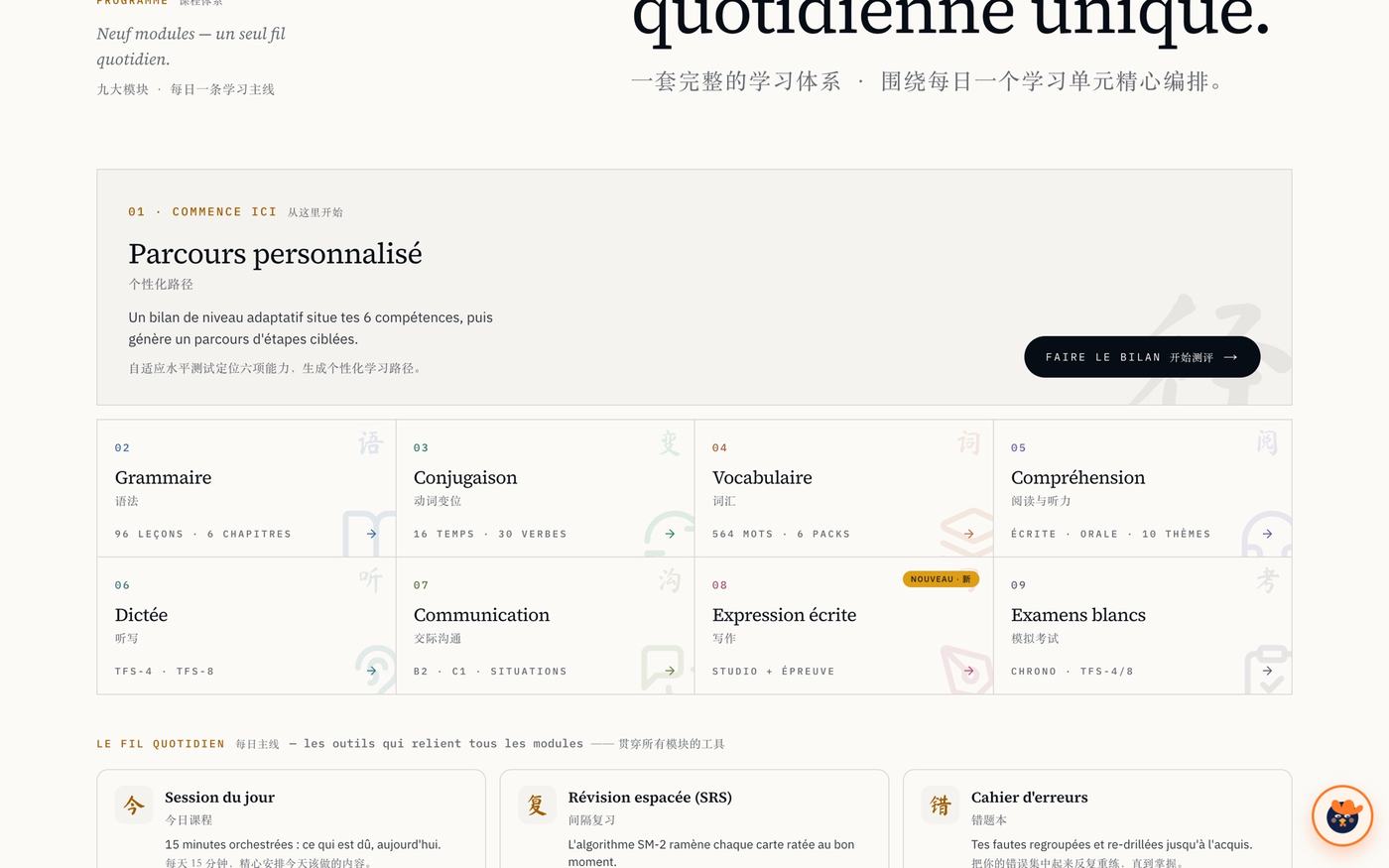
This is the distinction that governs everything else. A catalogue offers resources and leaves the student to decide; a pathway decides with them.
Every activity produces usable information: success, error, time spent, regularity, correction, reassessment. Those traces do not merely display a score — they determine what comes next. The loop has five moments: frame the goal and the exam date, interpret the gaps, prescribe a precise action, observe the result, then decide between progressing, remediating, or bringing in the teacher.
Let me say straight away what this adaptivity is not: it does not mean everything moves on its own. Unlock rules, thresholds and the teacher’s judgement frame the decision. Chapter assessments, for instance, only open once the corresponding lessons have been worked through — a deliberate constraint that guarantees ordered progress rather than scattered skimming. I preferred a system that sometimes refuses to one that lets you do anything.
Around that loop, a single daily thread: a “Today” page, around a quarter of an hour, chaining revision, vocabulary, a grammar point and dictation according to the needs of the moment. Nine modules — grammar, conjugation, vocabulary, reading and listening comprehension, dictation, communication, written expression, literature and civilisation, mock exams — but one single thing to do today.
Knowing where you stand, and saying so honestly
Everything begins with a placement test of about twelve minutes, genuinely adaptive: the questions adjust to previous answers. Out of it comes a heat map that distinguishes four states, not two — what is secure, what is fragile, what is a gap, and what has not yet been tested. The thresholds are explicit: secure from 75 %, fragile between 50 and 74 %, a gap below that. The student does not read a mark; they read a map.
Then the detail names the notions. On a real profile, past participle agreement moves to “fill in first”, while relative pronouns and the subjunctive after doubt, will or feeling are filed under “consolidate”.
This is where I had to reverse a decision. In an early version, the pathway displayed a number of steps even when the placement test had not been taken — a generic figure, which is to say a fabricated one. And the readiness score was displayed to the point. Both were polite lies. The platform now shows an explicit empty state until the positioning is recorded, and a range with a confidence level rather than a falsely precise score. Nor does an incomplete assessment drag the score artificially down to zero any more: a measured result, unfinished work, and an evaluation not yet available are three different things.
A preparation that overstates the precision of its own diagnosis is worth no more than no diagnosis at all.
A grammar you can see
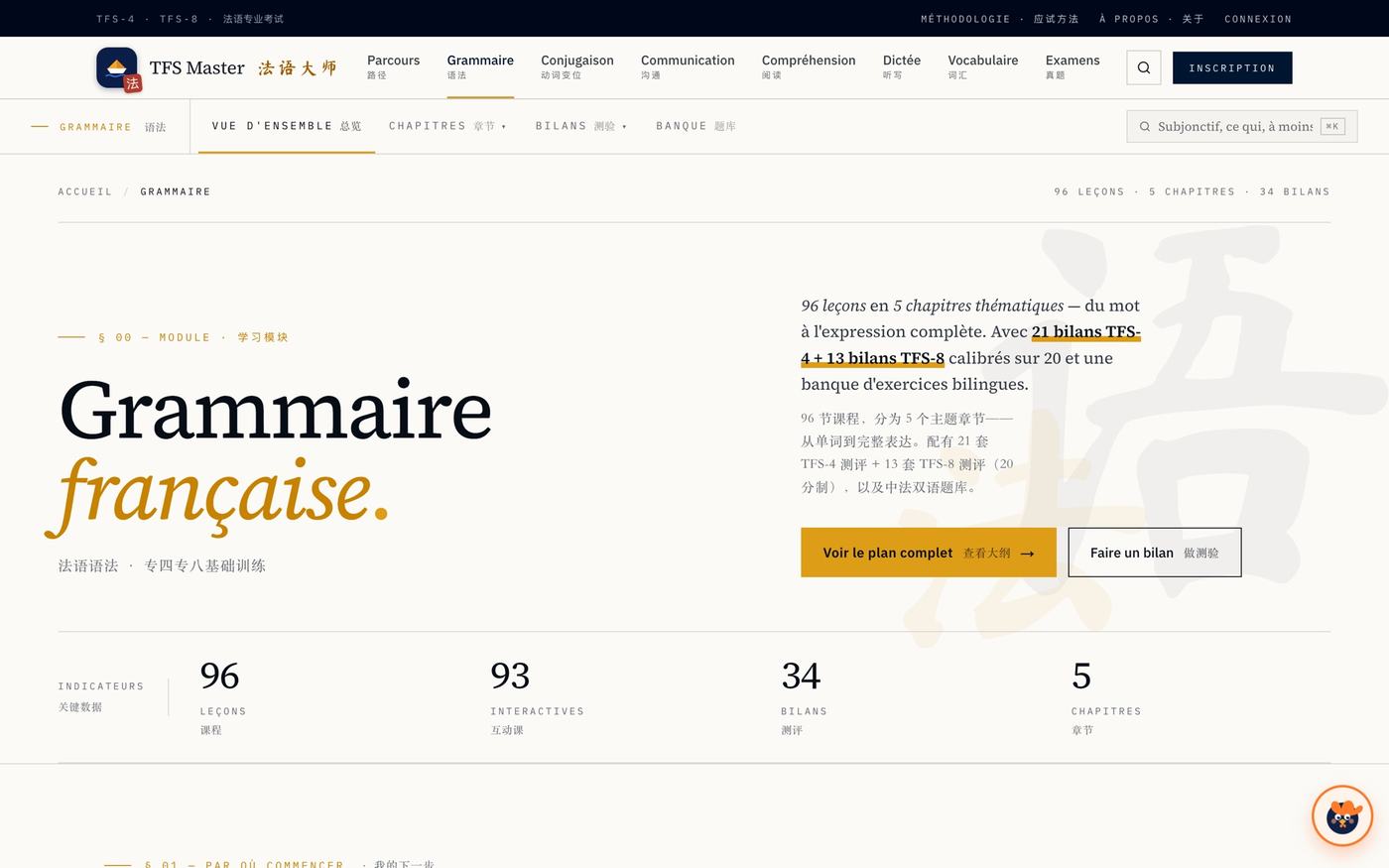
The grammar module holds 96 lessons in five chapters, from the word to the complete utterance, with 34 assessments graded out of 20. Every lesson follows the same structure, so students never waste time wondering where they are:
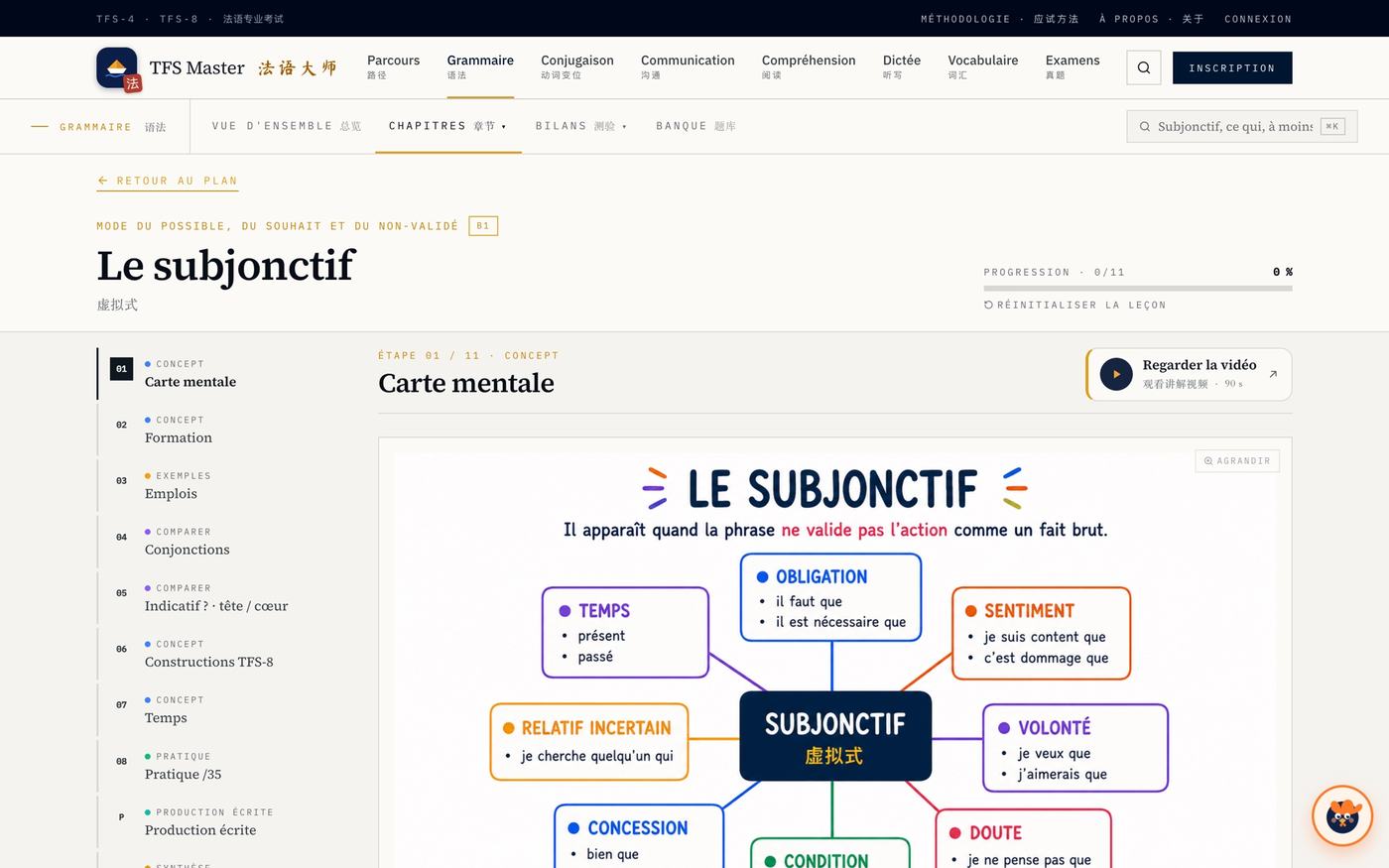
Take past participle agreement — the notion that costs the most marks. The lesson does not open with a list of rules, but with a decision tree: first identify the auxiliary — être, avoir or reflexive — then apply the corresponding rule. A single method, which settles ninety-five per cent of cases; the remaining five per cent are the TFS-8 particularities, handled later in the lesson.
This is what I meant by talking about painting. A decision tree is a form: you take it in at a glance, you handle it, you come back to it. A list of rules is not — it is recited and forgotten. The mind map that opens each lesson plays the same role.
Rules come with Chinese glosses. Not word-for-word translation: explanation for someone who thinks first in another language. And the lesson never separates explanation from practice — the tree leads straight into the exercises, whose corrections are bilingual too.
Lessons are free to read, no sign-up needed. Registration, which is free, only unlocks the exercises and their correction — because an exercise only means something if you really answer it.
The error as a resource: the error notebook
The 错题本 — cuòtíběn — is a study practice my students know before they know me: the notebook where you keep, sort and rework your mistakes. It has a proven record. My only contribution was to equip it.
The Journal keeps a trace of every session. The Diagnostic sorts the needs. The error notebook converts wrong or fragile answers into revision items, grouped by family — so that the student does not restart a whole chapter, but takes up a short, personal set drawn directly from their own answers. The results of that second pass update the competence map, which redirects the rest of the path.
Spaced revision sits on top of it: poorly mastered items come back at growing intervals until they are durably anchored, while mastered ones space out. The error stops being a negative result forgotten after correction; it becomes a resource for progress.
Vocabulary you hear and keep
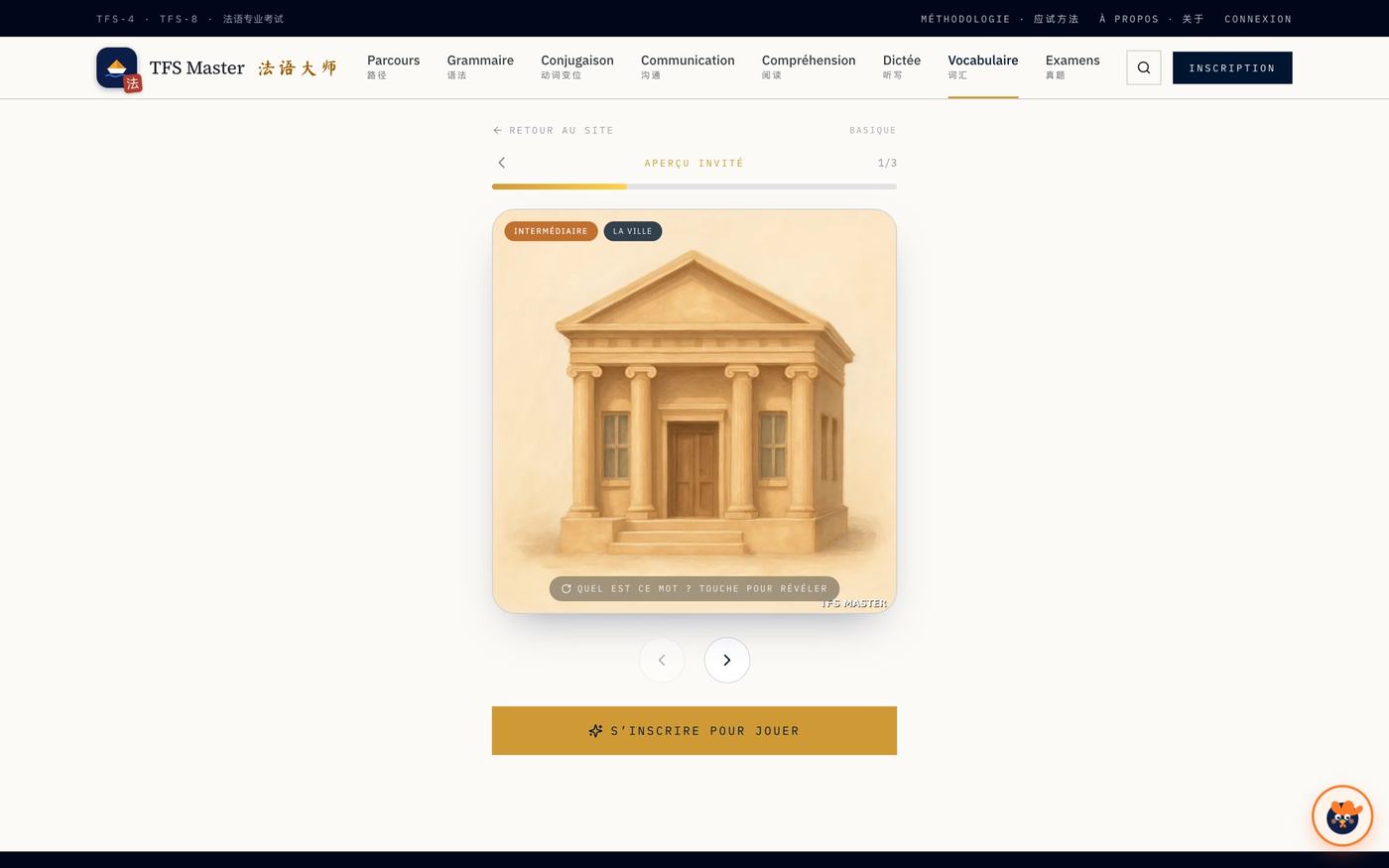
For vocabulary — 564 words in six packs — each word is seen (an image that anchors meaning), heard (a native speaker’s voice) and kept (phonetics, Chinese, then spaced revision). You guess first, then reveal — and you rate yourself honestly: “I know it”, “to review”, “I don’t know it”. It is that self-assessment, not an imposed score, that sets how often each card returns.
From the word to the scene
A purely grammatical progression produces students who know and stay silent. So the notion of the day is tied to a scene: a “Put it in situation” block carries the structure being worked on into a real intention — to argue, to refuse without offending, to say what you feel.
Those scenes are branching audio dialogues. The student listens, answers out loud, and the conversation evolves according to the answer.
For writing, the principle is fading scaffolding. In the writing studio, the assistant first builds an introduction in front of the student — the hook, then the problem statement, then the outline — explaining at each step the function of what it is doing. Then the student completes, then reformulates, then produces alone. Watch a gesture, understand its function, handle the structure, transfer it: that is exactly how one learns to paint.
What the machine does not do
Written production is marked with the help of artificial intelligence, and I would rather say so than let it be guessed. That correction is formative in purpose: it does not merely flag a mistake, it explains it — a mark out of 20, sub-scores by criterion, localised corrections, all of it in French and Chinese. But the verdict stays indicative: the teacher can reread it, adjust it or validate it, and it is the teacher who keeps responsibility for academic assessment.
Gaston, the bilingual assistant that accompanies navigation, follows the same rule: it points towards the site’s own content, it substitutes neither for the teacher nor for assessment, and the exchanges are not recorded.
The rest follows the same discipline. The platform carries no advertising network and no commercial tracking. Fonts, scripts and media are served in house, with no dependency on a public CDN. Reading the content stays free; only active interactions require an account. Access is structured by role, and sensitive actions are logged.
Finally, something the platform’s own dossier states and that I repeat here: TFS Master does not claim completed psychometric validation. The assessments are calibrated and the calibration bench is documented, but the empirical evidence is still being assembled. Saying otherwise would sell better, and be less true.
The teacher is not a spectator
The third obstacle — the load — called for its own answer. The teacher’s space is not a statistics board: it is a cockpit, and it requires no technical skill.
A teacher creates a class, invites students by code or e-mail, draws on a library of courses, exercises, dictations and comprehension passages filterable by module and level, and assigns in one click. They can start from a ready-made sequence or compose a tailor-made pathway, mixing the platform’s resources with their own documents. Alerts flag students in difficulty or inactive; each student’s record gathers lessons viewed, scores, dictations, homework and estimated level. A print centre produces reports paginated for paper and numbered for archiving.
In other words: the data serves to decide on a remediation, a piece of homework or some support — not to produce statistics nobody reads.
In your pocket
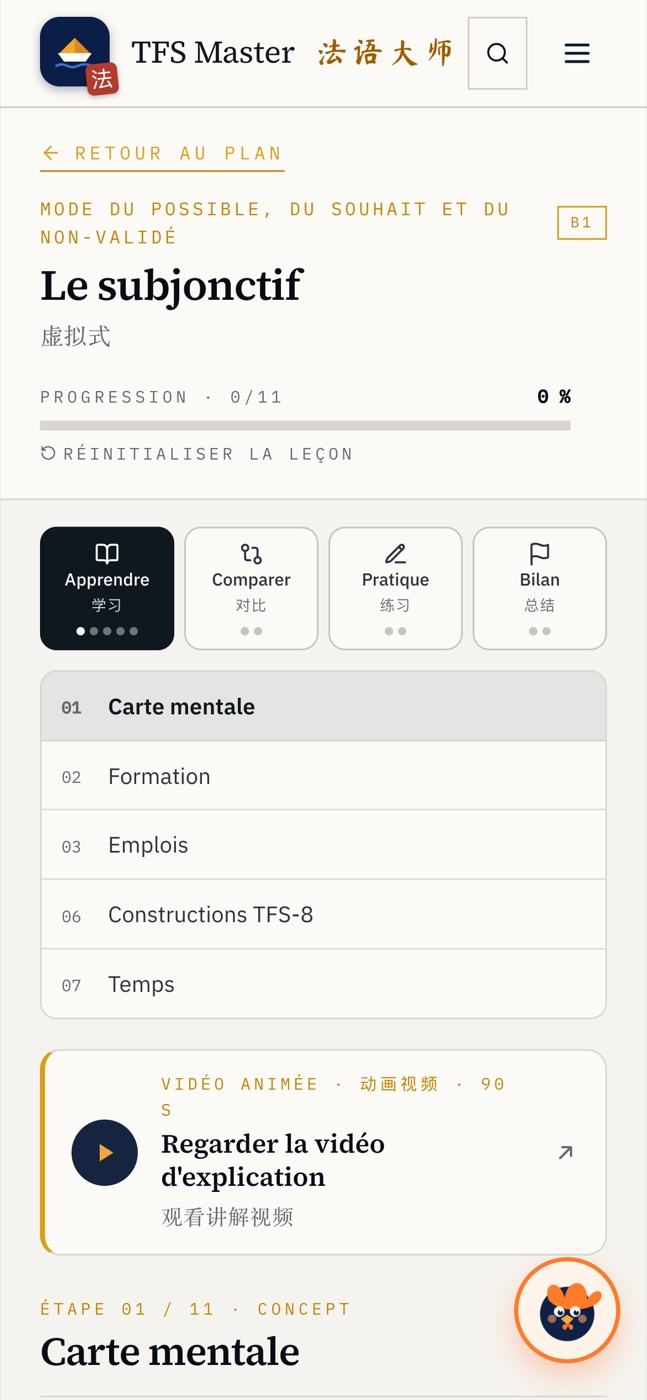
A phone is often the closest tool at hand for revising. So the platform is not a shrunken desktop page: navigation, menus and cards are rethought for the narrow screen, and an Android app lets students work offline.
What TFS Master is not
It is not a bank of exercises, nor a digitised textbook, nor a magic promise: progress comes from regularity, and no mechanism replaces the fifteen daily minutes.
Nor is it a substitute for the class. Nothing I have described claims to replace a teacher in front of a room — all of it is designed so that they see more clearly and mark less blindly.
What I wanted to build is a working companion: demanding, readable, bilingual, that meets students where they are and takes them, step by step, to where the exam awaits.
If you are a student, a teacher, or simply curious: the lessons are free to read at tfsmaster.com. The placement test is the best way in.


Conversation
Share your thoughts and join the discussion
No comments yet. Be the first to share your thoughts!